

With war in the Middle East now in its third week, both energy markets and financial markets are experiencing significant volatility. With hopes for a quick and decisive outcome waning, markets are being forced to adjust to a significant portion of global energy and derivatives being displaced from the larger markets.
Although the joint forces of the United States and Israel appear to command the skies over Iran, the Iranian regime’s ability to inflict damage on their GCC neighbors and direct indiscriminate attacks on merchant shipping traffic, commerce in the region has effectively ground to a halt. The U.S. has appealed to other nations to provide support for convoys, however most nations, except for France, seem reluctant to commit resources for fear of being drawn into the conflict.
Prior to the conflict, roughly 130-150 vessels of varying sizes and cargo types transited the Straits. Today, that number has dwindled down to almost nothing and an estimated 1,100 vessels remain trapped inside the Straits of Hormuz, reluctant to put their crew, cargo, and ship at risk to Iranian drone strikes. Outside of the Straits, an armada of commercial vessels are building up daily, unable to access critical resources stranded beneath the fog of war.
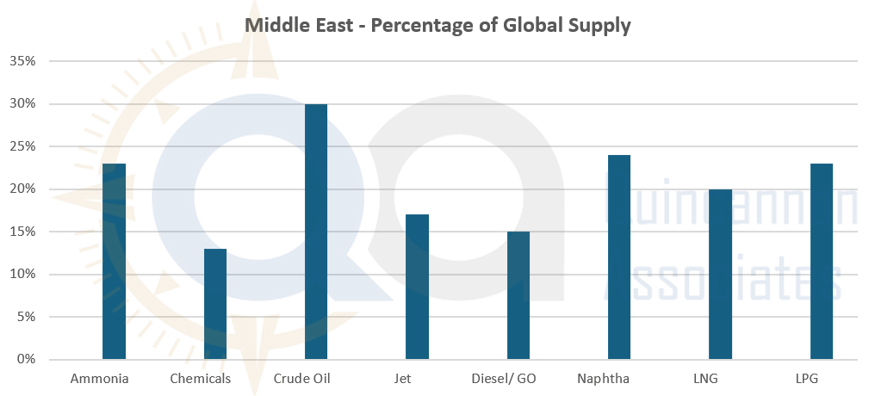
Mainstream media outlets have focused primarily on the impact of oil markets, with roughly 30% of global supply effectively cut off from global markets, but to understand the broader impact, one must look at the systemic impact the closure of Hormuz creates for the broader economy. Crude oil gets most of the attention, but the region is vertically integrated, with almost no “local markets” to supply, making the Middle East a push model into key markets abroad.
Upwards of 80% of Middle East crude oil flows to Asia, where it is used for energy and gets refined into various fuels and derivatives, including chemicals and olefins. Asia is also the primary outlet for the Middle East’s Naphtha production (60%) where it is used to make high-octane gasoline and olefins for the petrochemical industries. Asia also depends heavily on LNG and LPG sourced from the Middle East, representing 85% of the offtake volumes from the region. For Petrochemicals, ~70% of the volumes produced within the Straits of Hormuz also flow to Asia. Now, just eighteen days into the conflict, we are seeing growing shortages, which are having a domino effect on global volumes across the whole value chain, particularly in Asia which is so dependent on Middle East products.
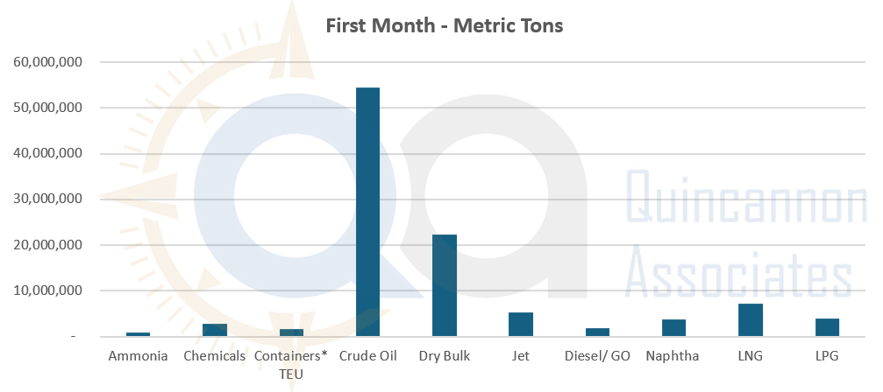
Quincannon Associates estimates that, even with Saudi Arabia and UAE capable of rerouting a portion of their oil exports through strategic pipelines built to bypass Hormuz, more than 60 million tons of products (Oil, Gas, Derivatives, Dry Bulk, etc.) have been taken out of the global markets. If the current trend persists, we will see this number breach the 100-million-ton mark, within the first month alone.
Freight Markets Respond, but what's next?
In the early days of the war, we have seen shipping rates spike as suppliers and consumers rush to secure space for alternative supplies that can keep their plants running. The pressure to shore up supply lines continues to mount, however it is becoming increasingly apparent that the loss of Middle East supply may be far too great for other sources to cover.
With Asian refining and production now in a steep decline, Owners are growing increasingly weary to send vessels East without viable means to return their ships. This is being amplified by the spike in bunker prices and growing fears of shortages. One ship Owner was quoted the waiting time in Singapore for bunkers could be as much as one month or more, if critical supply lines are not restored soon.
The result is that ships are being pushed west into the Atlantic Basin, in search of more fertile markets. Near-term, uncertainty and fear, coupled with high bunker costs, is supporting higher rates, however the influx of additional capacity is creating broader concerns about the sustainability of the Atlantic markets should these additional ships be forced to compete for the same volumes.
For the owners already contracted on specific routes, they face the growing challenge of finding suitable repositioning cargoes, which could mean costly ballast voyages, or rationalizing certain trade routes that are no longer serviceable.
The last six years have provided a series of crises, seemingly in rapid succession, and each time the shipping markets have emerged stronger. Time will tell what the long-term outcome will be from the current crisis, however with plants in the Middle East being forced to idle due to lack of offtake, it will take considerable time for volumes and trade flows to normalize, which will have a significant impact on the global economy moving forward.
Download the PDF of this article.

By Patrick Quincannon
President and CEO
Quincannon Associates